
In 1900, oysters were a Thanksgiving standard and the gravy was made with chopped giblets. If you eat tomorrow the way most Americans do now, your meal won’t pack in the nutrition your ancestors got from theirs.
You can get it back without dropping the turkey, dressing, mac and cheese, or even the pie.
What follows is a roadmap rather than a “recipe.” You know me as the Cronometer guy not the chef, so I’m doing what I do best and selecting foods and amounts that will get you to all my nutrient targets.
I give you the foods and the dishes, and you can cook them however you want.
It changes the modern American Thanksgiving just enough to hit my target for each and every nutrient and leave you truly Deficient in Nothing.
Most of the changes come straight from older Thanksgiving tables. Where a gap is left, a genuinely American food fills it, with a little color from my superfood list in the few places where its needed.
You don’t need to track a single nutrient tomorrow. I already ran the numbers, so you can spend the day with the people you love. All it takes is a few changes and one trip to the store today.
The Rise and Fall of the Nutrient-Packed Thanksgiving
1621. Thanksgiving harkens back to the dinner shared by colonists and Wampanoag that celebrated a successful harvest. The dinner definitely included some type of wild bird (perhaps wild turkeys), venison, and bread and porridge made from corn. It almost certainly included fish and probably included shellfish.
There were no pies, no sweet potatoes, and no cranberry sauce.
The first Thanksgiving was the most nutrient-packed because the scarcity of the situation kept out desserts or partially refined flours.
1863. In the half century leading into Lincoln’s proclamation of it as a national holiday, the turkey was stuffed with bread, eggs, herbs, and suet or salt pork. Or, it could be stuffed with mashed potatoes. Sides included cranberry sauce, pickles, or celery. Dessert was pumpkin pie made from milk, pumpkin, eggs, molasses, allspice, and ginger, in a crust. The flour of the crust had more of its germ due to the processing, which kept more of the vitamins. The crust would also include some type of fat, usually some combination of lard, butter, and eggs. Gravy was made with butter and flour.
Sweet potatoes and mac & cheese made their way into Thanksgiving meals from the southern states after the Civil War ended.
1900. Oysters were a Thanksgiving standard, and gravy was made with chopped giblets. Oysters faded from the scene leading into World War II due to pollution and over-harvesting, while the rationing of World War II led to cultural emphasis on consuming all of the organs to be economical.
Advances in flour milling in the late 1800s led to a major decline in the nutritional value of any Thanksgiving foods made from flour. Enrichment started in 1941, but enriched flour has never been made to resemble the nutritional profile of whole wheat. The first technological advancement was depletion. The second was distortion.
1912–1941. Big Marshmallow promoted marshmallow toppings in 1917. Big Cranberry Sauce piloted canned and jellied cranberry sauce in 1912 and launched it nationwide in 1941. This replaced most of the cranberry nutrients with sugar.
Green bean casserole was invented by Campbell’s to sell its mushroom soup.
Traditional mac & cheese was made from flour that had more germ than modern flour. During the Great Depression, Kraft released its boxed macaroni, which exploded the popularity of this dish. This expanded the use of fully whitened flour in Thanksgiving meals.
The Rise of Big Food led to a massive displacement of nutritious foods with sugar and fully refined flour. Interest in shellfish and organs declined after World War II.
The modern Thanksgiving has plenty of nutritious components, but it winds up mediocre in its nutritional value. The roadmap below supercharges your Thanksgiving with traditional American foods to get it back up to its measure.
What to Grab Today
A turkey with the giblets still inside, chicken livers, shucked oysters, unfortified nutritional yeast, whole-wheat pastry flour, a whole-wheat sourdough loaf and rolls, whole-wheat elbows, pure maple syrup, molasses, lard, fresh cranberries and an orange, red bell peppers, cremini mushrooms, frozen baby limas and corn, and salted almonds.
Each Food and What It Gives You
Turkey: four ounces of breast and two ounces of thigh give you protein, niacin, B6, and choline.
Giblet gravy seasoned with unfortified nutritional yeast: make this with the liver, heart, gizzard, neck, and egg; a half cup of it will give you plenty of vitamin A, B12, riboflavin, and choline.
Oyster and chicken liver whole-wheat sourdough dressing: a cup of this will give a hefty load of vitamin A, zinc, folate, biotin, and riboflavin.
Mashed potatoes, seasoned with unfortified nutritional yeast: one and three quarters of a cup of this gives you a power-punch of potassium, a useful amount of B6 and vitamin C, and, from the yeast, enough thiamin and folate to cover even pregnancy.
Maple butter sweet potatoes: a cup of these gives you another good dose of potassium, with B6 and riboflavin to boot.
Baked mac & cheese: a half cup of this specializes in calcium.
Homemade green bean and cremini casserole: one and a half cups of this gives you riboflavin, potassium, and folate.
Succotash made from baby lima beans, corn and cream: three quarters of a cup of this gives you potassium, with the limas specializing in molybdenum.
Raw cranberry-orange relish with maple syrup: a half cup of this gives you vitamin C, riboflavin, and manganese.
Relish tray with red pepper strips, celery, dill pickle, olives, and salted almonds: three quarters of a large pepper, one celery stalk, half a pickle, four olives, and thirty almonds give you vitamin C, vitamin E, and riboflavin.
Deviled eggs: three halves specialize in biotin and choline.
Molasses pumpkin pie and maple whipped cream: 1/8 of the pie gives you potassium, iron, and magnesium.
Coffee: served with your pie, it will give you some extra riboflavin and potassium.
Salt: it provides itself. It’s a nutrient.
A whole-wheat dinner roll with butter (bonus for 24-hour sourdough): one roll with a teaspoon of butter gives you vitamin A, manganese, magnesium, and selenium.
Sweet potatoes and almonds are very high in oxalate. Potatoes are moderate. Smaller amounts are found in the celery, olives, lima beans, and roll. A low-oxalate version replaces sweet potatoes with butternut squash, almonds with a tablespoon of sunflower seeds, and potatoes with mashed cauliflower, and it replaces the celery, olives, lima beans, and roll with more corn. To keep riboflavin and B6 on target, it also uses breast meat only, smaller portions of the grain dishes and mac & cheese, and more red pepper, mushrooms, milk, and maple syrup. This cuts the oxalate load almost six-fold and keeps every target met.
The whole wheat in the flour, bread, and pasta adds a little oxalate, so the low-oxalate version lands at about 100 mg. Anyone who needs more oxalate reduction can use white flour, bread, and pasta instead of whole wheat.
Doing so also reduces manganese for anyone who needs to lower it.
For a more authentic mac and cheese, use unenriched durum semolina macaroni instead of whole wheat. Macaroni was made this way long before enrichment. It costs a little thiamin, folate, and fiber, but it doesn’t cause you to lose any targets.
What Leaving Out These Foods Costs
Without the livers, giblets, and neck in the gravy, riboflavin drops below target.
Riboflavin also drops below target if maple syrup isn’t used as the sweetener.
Without raw red pepper in the relish, vitamin C drops below target.
The oysters in the dressing and the molasses in the pumpkin pie are great for the nutrition, but if you leave them out, no targets are lost.
The potassium in this meal is so jam-packed that you can leave out the drippings from the gravy, or even the potatoes, and still hit the potassium target. Don’t cut the potatoes, though: they carry B6 and most of the nutritional yeast.
Personalize It With Cronometer
If you want to test how modifying these ingredients impacts the nutrition, use these entries:
Personalize It With Cronometer
If you want to test how modifying these ingredients impacts the nutrition, use these entries:

Use my Custom Nutrient Targets. Then modify each food as you like and test how it impacts the daily nutrition report. I have more guidance on using Cronometer here.
These Cronometer entries underestimate biotin in everything, underestimate thiamin and overestimate riboflavin in the yeast, underestimate your preservation of B vitamins if you use the drippings, and don’t measure molybdenum at all.
You can substitute branded Sari nutritional yeast for the baker’s yeast in Cronometer. This will lead to incomplete data on many nutrients but make the B vitamins presumably more accurate.
These entries also underestimate folate and the fat-soluble vitamins, especially vitamin E, and perhaps many other nutrients, if you are using high-quality pastured animal products.
Below is how these foods apportion into dishes.
Thanksgiving Recipe Roadmap for 8
As covered in The Best Way to Store Meat Is as a Cow, make sure to follow these two rules:
90 minutes kept hot is the inflection point where you lose more nutrients by keeping it hot than you do by chilling it and reheating it. If you’ll eat it within 90 minutes, keep it hot. If you want it hot two hours later, refrigerate it as soon as you’re done with it.
When you thaw, boil, simmer, and roast, use 100% of the thawing juice, cooking water, and drippings. Throw them in the gravy and simmer them off.
Roast turkey
Whole turkey with giblets: one 12–14 lb bird.
Giblet stock: neck, heart and gizzard + 1 onion + 2 celery ribs + 5 cups (1.2 L) water; makes the 4⅔ cups (1,120 g) of broth used below.
Giblet gravy
Turkey fat from the pan: 56 g or ¼ cup
Flour (whole-wheat pastry): 48 g or 6 Tbsp
Broth (pan juices + giblet stock): 720 g or 3 cups
Turkey liver: all of it. Cook this separately till just done and throw in at the end.
Heart, gizzard, neck meat: all of it
Hard-boiled eggs: 2 large (100 g)
Nutritional yeast (unfortified): 42 g or 5 heaping Tbsp. Add this at the end, off-heat.
Oyster and chicken-liver sourdough dressing
Whole-wheat sourdough bread: 456 g, 10 cups cubed, or a 1-lb loaf
Butter: 85 g, 6 Tbsp, or ¾ stick
Onion: 160 g, 1 cup diced, or 1 medium onion
Celery: 160 g, 1½ cups diced, or 4 ribs
Chicken livers: 168 g, ¾ cup, 6 oz, or about 5 livers
Shucked oysters with liquor: 280 g, 1¼ cups, 10 oz, or about 20 oysters
Eggs: 3 large
Broth: 400 g, or 1⅔ cups
Herbs: sage, thyme, marjoram, summer savory, parsley, pepper, to taste
Skin-on mashed potatoes
Potatoes, boiled whole in skins: 2,720 g, 6 lb, or about 8 large potatoes; you can peel them after boiling, but boiling with skins on prior to cutting preserves the minerals. Buy potatoes that are large; have no green, sprouts, or bruising; and have been kept out of the light.
Butter: 106 g, 7½ Tbsp, or about 1 stick
Whole milk: 457 g, or 1⅞ cups
Nutritional yeast (unfortified): 126 g, 16 heaping Tbsp, or about 1 cup. Add this at the end, off-heat.
Maple-butter sweet potatoes
Sweet potatoes, baked (flesh): 1,760 g, 7 cups mashed, 5½–6 lb raw, or about 8 medium
Butter: 52 g, 3¾ Tbsp, or about half a stick
Maple syrup (pure): 131 g, 6½ Tbsp, or a generous ⅓ cup
Baked mac and cheese
This dish is kept small because it is here for its popularity, not its nutrition.
Whole-wheat elbow macaroni: 150 g dry (336 g cooked), 1¼ cups dry, 2½ cups cooked, or 5 oz
Butter: 19 g or 1⅓ Tbsp
Whole-wheat pastry flour: 14 g or 1¾ Tbsp
Whole milk: 293 g or 1¼ cups
Sharp cheddar: 192 g, 1¾ cups shredded, or a bit under half a 1-lb block
Green bean and cremini casserole
Green beans, fresh: 816 g cooked, 6½ cups, or 2 lb raw
Cremini mushrooms: 1,120 g, 15½ cups sliced, 2½ lb, or about five 8-oz packs
Butter: 50 g or 3½ Tbsp
Whole-wheat pastry flour: 38 g or 5 Tbsp
Whole milk: 439 g or 1¾ cups
Heavy cream: 72 g or 5 Tbsp
Onion (crispy topping): 180 g or 1 large onion
Succotash
Baby lima beans, frozen: 456 g, 3 cups, or one 1-lb bag
Corn, frozen: 456 g, 3 cups, or one 1-lb bag
Butter: 28 g or 2 Tbsp
Heavy cream: 60 g or ¼ cup
Raw cranberry-orange relish
Fresh cranberries: 408 g, 4 cups, or one 12-oz bag plus a big handful
Navel orange, peeled: 240 g or 1 large orange
Maple syrup (pure): 192 g or a scant ⅔ cup
Relish tray
Red bell peppers, strips: 960 g or 6 large peppers
Celery: 320 g or 8 ribs
Dill pickles: 240 g or 4 whole pickles
Ripe black olives: 120 g or 1 cup
Salted dry-roasted almonds: 320 g or 2¼ cups
Deviled eggs
Eggs, hard-boiled: 12 large
Mayonnaise: 88 g or 6 Tbsp
Mustard, paprika, salt: about 1 Tbsp mustard; paprika and salt to taste
Whole-wheat sourdough rolls
Get the best available to you, one roll per person.
Butter for the table: 40 g or 3 Tbsp
Molasses pumpkin pie with maple whipped cream
Crust: whole-wheat pastry flour: 156 g or 1⅓ cups
Crust: lard: 104 g or ½ cup
Crust: salt and ice water: ½ tsp salt and 3–4 Tbsp ice water
Pumpkin, canned: 425 g or one 15-oz can
Whole milk: 300 g or 1¼ cups
Heavy cream (filling): 120 g or ½ cup
Eggs: 3 large
Molasses, medium: 168 g or ½ cup
Spices: 1 tsp ginger, ½ tsp allspice, pinch of salt
Topping: heavy cream + maple syrup: 120 g (½ cup) cream whipped with 40 g (2 Tbsp) maple syrup
Coffee
One cup per person with dessert.
How Much Each Person Eats
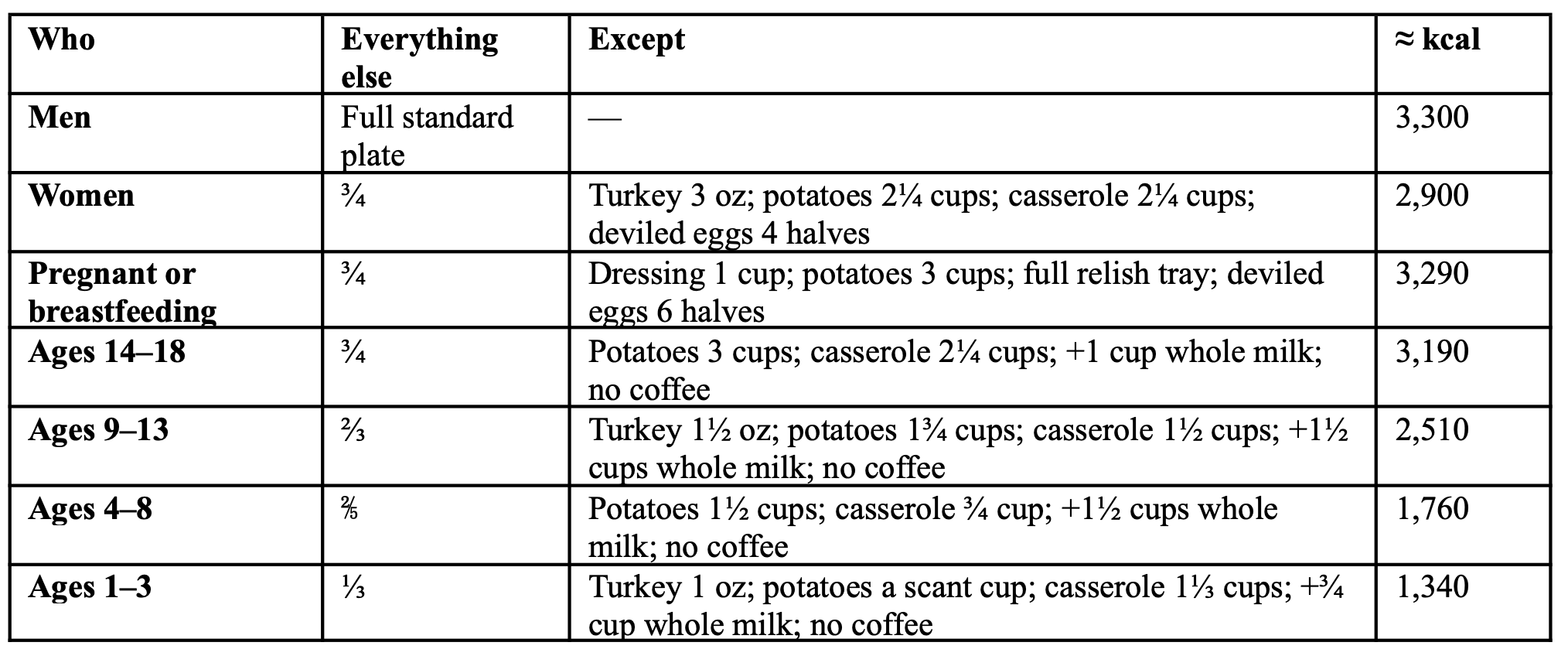
The standard plate for an adult man is 6 oz turkey (4 oz breast, 2 oz thigh); ½ cup gravy; 1 cup dressing; 1¾ cups mashed potatoes; 1 cup sweet potatoes; ½ cup mac and cheese; 1½ cups green bean casserole; ¾ cup succotash; ½ cup cranberry relish; relish tray (¾ red pepper, 1 celery rib, ½ pickle, 4 olives, 30 almonds); 3 deviled egg halves; 1 roll with 1 tsp butter; ⅛ of the pie; 1 coffee.
This assumes that you’re eating more food than you usually would because it’s Thanksgiving.
If you want to keep the nutrients up and roll back the calories, skip the pie, the mac & cheese, and the roll, and drink a cup of whole milk (or substitute yogurt or kefir) instead. If you’re pregnant or breastfeeding, do that and add one more deviled egg half.
The dishes with liver, as scaled this way, provide more vitamin A than children should get for a daily average. Just leave the liver out of their diet for the rest of the week and this resolves itself.
Foods are increased or added for women and children to keep the targets up. Mashed potatoes are increased to keep B6, potassium, thiamin, and folate up to target. The casserole is increased for the riboflavin in the mushrooms. The eggs are added to keep choline on target. Turkey is reduced to keep the B6-to-protein ratio on target. The addition of whole milk is for riboflavin and calcium.
Keep the Spirit of Thanksgiving
None of this is meant to have you tracking nutrients at the table. Do a little planning today, then forget about it tomorrow and spend the day with the people you’re grateful for.
Happy Thanksgiving!
Photo credit: Jack Delano, 1940, Library of Congress.