

My paternal grandmother was a Greek immigrant to America. Genomic data indicates that my paternal lineage can be traced back to the earliest Neolithic farmers. Farming is only about 12,000 years old, and only some human lineages are descended from Neolithic farms. That is a short window of time, in evolutionary terms.
The genus Homo is more than two million years old. For almost all of that time, people lived as hunter-gatherers, with different human lineages occupying different environments and adapting to different diets. This article goes into more detail.
Although 12,000 is considered “short” on evolutionary timescales, it turns out to have been plenty of time for evolutionary forces to drive considerable adaptive change to a more sedentary agricultural environment. A recent paper from David Reich’s group at Harvard documented this. It looked at ancient DNA from about 16,000 West Eurasians in the last ~10,000 years.
Since the mid-20th century, academia has been dominated by the idea that all humans are more or less biologically interchangeable, with differences that are mostly superficial and skin deep. 20th century biologists like Stephen Jay Gould led the charge in asserting that human evolution pretty much stopped a very, very long time ago. He argued that natural selection had almost no role in explaining the phenotypic diversity seen in modern humans, especially as it relates to the brain and behavior.
The new paper adds to the evidence against this view. Human evolution did not magically stop in the deep past. There is plenty of meaningful, heritable variation between modern human populations. The idea that all humans are basically the same is dangerous from a metabolic health standpoint because it assumes that what’s good for one will be good for all. No true. A great example of this is the genetic variation in human fatty acid metabolism, which I discuss in detail here.
After farming began, directional selection not only acted, it picked up: lactase persistence, fatty-acid genes, and cardiometabolic traits all changed since the advent of farming. And not just “metabolism” traits, either. There were shifts in gene variants related to everything from body fat percentage to psychiatric disorders and cognitive ability.
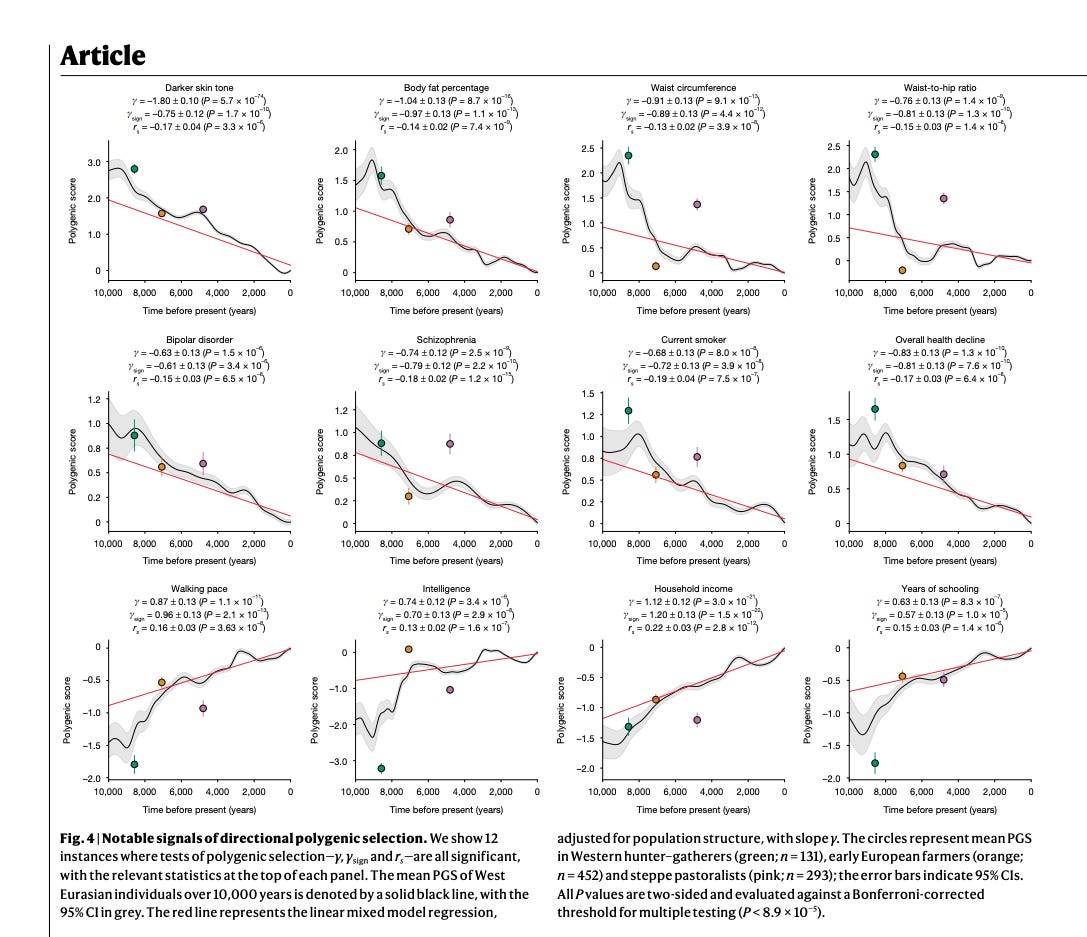
This is why there is no singular human diet or lifestyle that is universally “optimal” for all living people. I go into much more detail in the article, What Did Humans Evolve to Eat? The full essay is freely available until next week.
Upcoming Podcasts:
Last episode | Endocannabinoid Biology in Health & Disease | Nephi Stella | Episode 305 | Listen here
Current episode | Human Brain Evolution & Development | Christopher Walsh | Episode 306 | Listen here
Next episode | Fructose: Human Clinical Trials | Kimber Stanhope (Sept 15)
Early access to new episodes available to paid subscribers on Substack.
Future Guests:
Artemis Simopoulos, MD (Endocrinologist) | Omega Fat Ratio in Health & Disease
Chris Brunet (Investigative Journalist) | Rampant Fraud in Academic Research & Publishing
Charles Brenner, PhD (Biochemist) | Longevity Science: Hype vs. Reality
Sir Stephen O’Rahilly, MD (Endocrinologist) | GDF15, Mitochondria & Metabolic Stress (Oct 5)
Other News:
Traveling to Florida this week. No new podcast episode.
NEW article | Resveratrol & Calorie Restriction for Longevity: Should you believe the hype?
Research Highlights
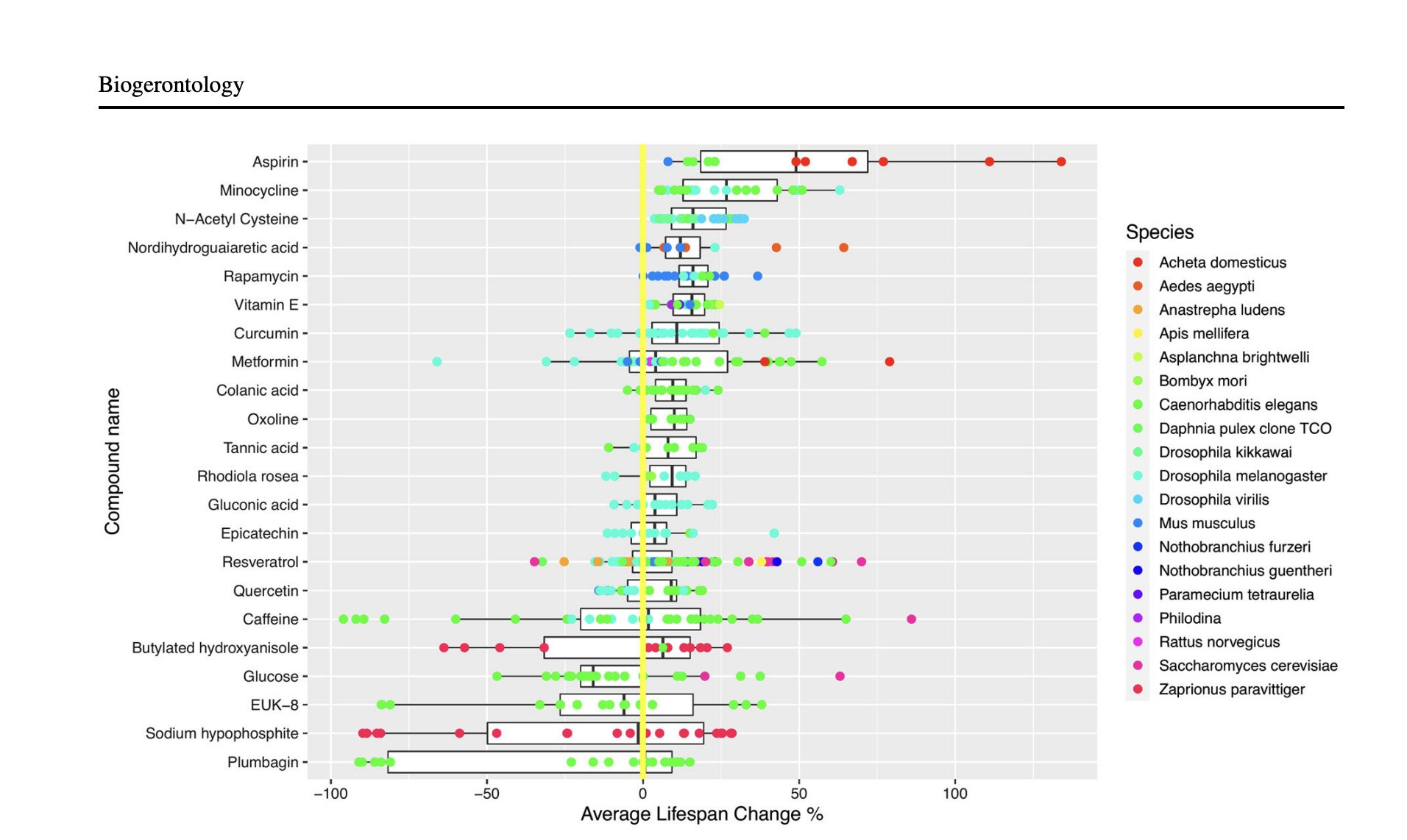
This paper looked at the average benefits of various lifespan-extending compounds across a bunch of different species, from unicellular organisms to vertebrates.
Note the average difference between compounds, as well as the variance across species for each one.
Aspirin came up on top. Famous longevity compounds like resveratrol don't look very impressive. More discussion in my new article on longevity science.
Does calorie restriction increase lifespan?
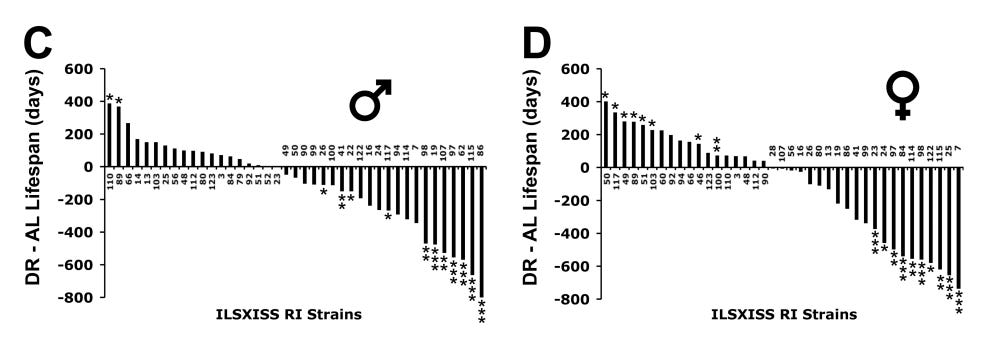
Many people seem to think the answer is an unequivocal, “Yes.” In reality, the effects of calorie restriction depend on species and strain. In lab animals, calorie restriction can help or hurt longevity. In multiple species, longevity benefits from calorie restriction are often stronger in the shortest-lived strains.
More detail in the new article.
As always, use this content to access studies that are behind a paywall.
Past Episode Worth Revisiting:
M&M 160 with Dr. Eugene Morin: diet, hunting, culture, and the evolution of Paleolithic humans and hunter-gatherers. A long conversation on what people actually ate before farming, and how hunting and gathering changed with the invention of tools and fire. Here’s a video clip:
Work with me: speaking engagements, workshops, or personal health consultation & biomarker analysis:
